Pasqueflower
Steeped in legend and religious connections, it flowers at Easter - known as the ‘Anemone of Passiontide’
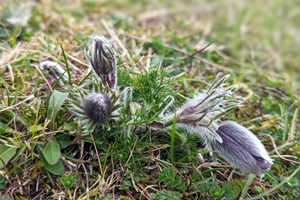 April is a special month for me, for many reasons. But especially as it’s a time when we spend a lot of time together as a family, the weather is getting warmer, the woodlands are waking up to carpets of ancient woodland indicators like bluebells and wood anemones, and it is Easter! So combining all of those, I came up with writing about the pasqueflower (Pulsatilla vulgaris), a beautiful and rare little flower that you need to hunt for to catch sight of, has strong connections to Easter, and is, of course, steeped in legend!
The pasqueflower is one of Britain’s most distinctive and evocative wildflowers, admired for both its delicate beauty and its deep cultural associations. Flowering in early spring, often around Easter, this plant has long captured the imagination of botanists, poets and folklorists alike. Yet despite its charm and symbolic richness, it has become increasingly rare, making it not only a botanical treasure but also a conservation concern.
Identification
In appearance, the pasqueflower is both striking and subtle. It typically grows low to the ground, reaching around 10 to 25cm in height, which means it can be quite hard to spot, me having spent a lot of time searching for this species!
Its flowers are drooping bell-shaped and usually a rich violet or purple. At the centre of the flower is a cluster of bright yellow stamens, providing a vivid contrast to the purple outer parts, which is just so beautiful. The entire plant is covered in fine, silvery hairs, giving it a soft, downy texture, which makes it glow in sunlight.
After flowering, the plant produces distinctive seed heads — feathery, plume-like structures that resemble small tufts of smoke or wisps of hair, adding another layer of visual interest.
Where to see it
Pasqueflowers are typically found on undisturbed calcareous grasslands, where conservation grazing is present. In the UK, they are most famously associated with areas such as the Chiltern Hills, parts of East Anglia, and a few sites in the Midlands.
They favour well-drained, sunny slopes where the soil is shallow and poor in nutrients, conditions that limit competition from more aggressive plant species and grasses that can out-compete them, hence leading to their decline. Historically, pasqueflowers were more widespread, but today their distribution is highly fragmented, often confined to nature reserves or isolated patches of suitable habitat. However, we are lucky enough to have them growing at Martin Down NNR, which sits in the middle of our Martin Down Farmer Supercluster, which I have the joy of working with.
Why is it rare?
In England it has undergone a dramatic decline over recent millennia, and its current distribution now represents just 27% of its former range.
The rarity of the pasqueflower is largely due to changes in land use over the centuries. Traditional grazing practices, which once maintained grasslands, have declined or been replaced by more intensive agricultural methods. Ploughing, fertilisation, and the conversion of grassland into arable fields have destroyed much of the plant’s natural habitat. Even where land has not been cultivated, the cessation of grazing can lead to the encroachment of scrub and taller vegetation, which shades out the low-growing pasqueflower. Additionally, its slow growth and specific habitat requirements make it difficult for the species to recolonise new areas once lost. As a result, it is now considered nationally rare and a protected species.
Conservation status
- Classified as Vulnerable on the Vascular Plant Red Data List for Great Britain
- Priority Species under the UK Post-2010 Biodiversity Framework
- Listed as Near Threatened on the global IUCN Red List of Threatened Species
The Easter flower
The pasqueflower’s connection to Easter is reflected in both its common name and its flowering time. It is known as the ‘Anemone of Passiontide’, and its common name is derived from the Old French pasque, meaning Easter. The plant also typically blooms in early spring, often coinciding with the Easter period, and its striking purple is an important colour in Christianity. Purple signifies penance, preparation, and a time of self-reflection, which is why this colour is worn by clergy during Lent.
Folklore and legend
Beyond its seasonal symbolism, the pasqueflower is steeped in folklore and legend. One enduring legend suggests that the flowers sprang up in places where the blood of fallen Romans or Danes landed, because they often appeared on old barrows and boundary banks. However, it’s more likely that these sites are favoured because they tend to be undisturbed chalk grassland.
Another Christian legend holds that pasqueflowers grew in abundance on the slopes of Calvary, the site of the crucifixion, linking the plant directly to the story of Christ’s death and resurrection. In this context, the drooping shape of the flower has sometimes been interpreted as a sign of mourning or humility.
There are also more whimsical tales associated with the plant. In some European traditions, pasqueflowers were believed to be favoured by fairies, who were said to shelter within their bell-shaped blooms. The silky hairs covering the plant were thought to protect it from cold winds, but they also contributed to its almost magical appearance, as though dusted with frost or spun from silver.
In certain folk practices, the plant was used in love potions or as a charm, though it is worth noting that Pulsatilla vulgaris is toxic and should not be ingested!!
In conclusion, the pasqueflower is far more than just a pretty little spring bloom. Its unique appearance, specialised habitat, and fragile status make it an important species from both ecological and conservation perspectives. At the same time, its deep-rooted connections to Easter and its rich body of folklore give it a cultural significance that few plants can match. As efforts continue to protect and restore its habitats, the pasqueflower remains a poignant symbol of both the beauty and vulnerability of the natural world.
Megan Lock
Advisory
Photo credit: Megan Lock