By Ben Jones, Allerton Project Farm Manager
Good crop establishment
I’m pleased to report that after the initially patchy emergence of the wheat crops, we got the rain we needed, and they’ve all come through and evened up nicely. Only the beans have yet to appear, but they were drilled as deep as possible because we don’t want them to emerge until late November when chocolate spot is less likely to occur.
Improvements to subsoiler
We recently had a catch-up with Philip Wright, who has a long history of advising Allerton and is one of the UK’s leading experts on tillage. In line with Philip’s approach, in order to keep soil disturbance to a minimum, we try to avoid any secondary cultivation after subsoiling such as using discs, or power harrowing. One of the drawbacks of this is it can leave the soil surface uneven. For this reason, we changed the points on the Sumo subsoiler to Metcalfes, which have flatter wings, are thinner (15mm rather than 20mm) and set at a flatter angle. As well as creating a more even surface to drill into, this minimises soil disturbance and the points are wide enough apart to leave channels of undisturbed ground from which any damaged fungal structures can reestablish.
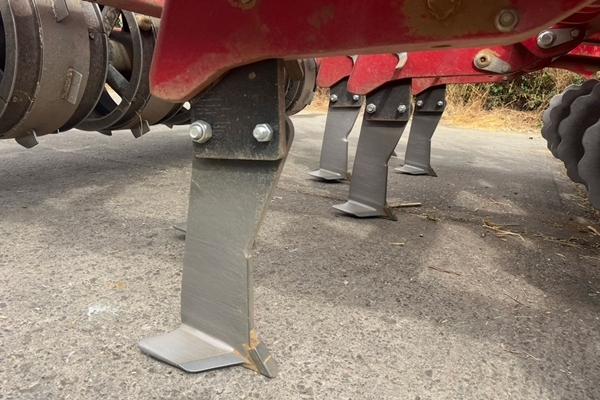
Subsoiler used at Allerton
Changing tractor tyre pressures
Philip had good advice on changing tyre pressures. We have high-quality Michelin tyres on the Massey Fergusen tractor, which allow you to drop the pressure right down to reduce ground compaction. For some jobs when you have a heavy attachment like the sprayer, you need higher pressure, but for drilling you can go as low as 8 PSI. Up to now, I have set the pressure somewhere in the middle, but Philip suggested taking the time to change them depending on the job, would make a real difference in terms of compaction reduction.
Avoiding wet conditions
To minimise compaction, it is also critical to avoid being on the ground when it’s wet, which is harder with crops like maize, which is harvested late and in the wrong conditions can cause a huge amount of damage to the soil. Our whole rotation is designed to try to avoid wet weather. Linseed, oilseed rape and winter cover crops are all planted early either at the end of August or start of September and we’ve brought our winter cereal drilling forward from October to September. In line with this, we do our subsoiling straight after the combine, so the ground is ready to drill as soon as possible. However, a lot comes down to luck in terms of the weather. We’ve had a couple of good years when it has been extremely dry and we’ve been able to get on the fields and do what we need to do without causing any damage.
Covering the ground
The other key thing to avoid compaction caused by rainfall is to avoid leaving any bare ground over winter, so we make sure we’ve got something covering the ground in every field either a cover crop or even chopped straw, which helps to protect the soil.