By Jayna Connelly, Science Communicator
When people think of wildflower meadows, they often picture colourful displays of orchids, knapweeds and oxeye daisies buzzing with pollinators. What is less obvious is the careful management required to create and maintain these habitats, and the important role that farmers play in ensuring they continue to support wildlife alongside productive agriculture.
National Meadows Day provides an opportunity to celebrate one of our most valuable yet threatened habitats. Over the last century, species-rich grasslands have declined dramatically across the UK, taking with them many of the plants, insects and birds that depend upon them. Restoring and managing meadows is therefore not simply about preserving beautiful landscapes, it is about reversing biodiversity loss and creating resilient ecosystems for the future.
A meadow doesn't happen by accident
It's easy to think of a wildflower meadow as a piece of land that has simply been left alone. In reality, some of our best meadows exist because of careful management.
Wildflower diversity is often highest where soil fertility is relatively low. When nutrients become too abundant, vigorous grasses, nettles and other competitive species can quickly take over, squeezing out many of the flowers that support pollinators and other wildlife.
That is why hay cutting, removing vegetation and sympathetic grazing are so important. They help keep nutrient levels in check and create opportunities for a wider range of species to thrive.
And sometimes nature does the rest. While seed mixes can help, it is often surprising what emerges when the conditions are right. Disturb a patch of soil or reduce competition from dominant plants and seeds that have been lying dormant for years can suddenly reappear, bringing a burst of diversity back into the landscape.
The meadow-making power of yellow rattle
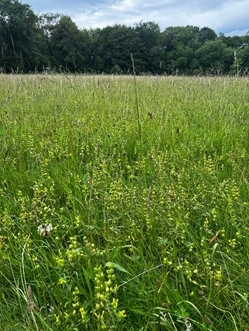 Few plants illustrate this better than yellow rattle (Rhinanthus minor). Often called the "meadow maker", yellow rattle is a semi-parasitic plant that takes nutrients from the roots of surrounding grasses. By reducing the vigour of dominant grasses, it creates space and light for a wider range of wildflowers to establish and persist.
The impact can be striking. During a recent visit to a meadow, I came across a field containing more yellow rattle than I had ever seen before. The effect was immediately apparent. Rather than a sea of dense grass, the meadow supported a rich variety of flowering plants, while butterflies and moths drifted across the field taking advantage of the abundance of nectar sources and larval food plants. It was a vivid reminder that seemingly modest species can play an outsized role in shaping entire ecosystems.
Meadows support specialists, not just generalists
One of the greatest values of species-rich meadows lies in the specialist wildlife they support. Rare species are often rare because they have very particular habitat requirements. Unlike generalist insects that can utilise a wide variety of plants, many specialists depend on a narrow range of food sources. When those plants disappear, so do the insects that rely upon them.
The cinnabar moth provides a well-known example. Its striking black-and-yellow larvae depend heavily on ragwort as a food plant. Although ragwort can be controversial in some settings, it plays an important ecological role and supports a range of invertebrate species.
Many solitary bees are similarly specialised:
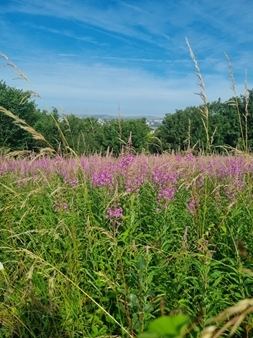 The Small Scissor Bee (Chelostoma campanularum) relies on bellflowers (Campanula species) for pollen. This unassuming bee may only be found foraging deep within these flowers and otherwise hiding within existing cavities in dead wood and hollow stems. A seemingly small population of bellflowers can therefore provide an important resource for a species that many people never notice.
Its close relative, Chelostoma florisomne, demonstrates just how specialised some pollinators can be. Rather than bellflowers, it favours plants such as buttercups, speedwells and roses. Despite belonging to the same genus, the two species have very different floral preferences, illustrating just how the complex the relationships between insects and plants can be!
Another fascinating example is the Yellow-loosestrife Bee (Macropis europaea). Found primarily in wet meadows, marshy grasslands and floodplain habitats, this bee has a unique association with yellow loosestrife (Lysimachia vulgaris). Females collect not only pollen but also floral oils, which are used to line and waterproof their nests. This remarkable adaptation highlights how closely some species are tied to individual plants.
The Long-horned Bee (Eucera longicornis) is less specialised but is still strongly associated with flower-rich grasslands, particularly those containing legumes such as bird's-foot trefoil. Perhaps best known for the extraordinarily long antennae of the males, it is one of our most distinctive and charismatic meadow pollinators.
Farming and nature working together
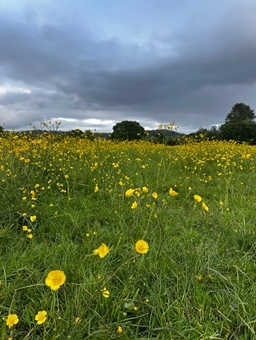 Wildflower meadows are often viewed as symbols of conservation, but they are equally symbols of stewardship.
The most successful meadows are rarely the result of neglect. Instead, they reflect thoughtful management, practical farming knowledge and a commitment to maintaining healthy ecosystems over the long term. Through grazing, cutting, habitat restoration and participation in environmental schemes, farmers play a vital role in creating the conditions that allow wildlife to thrive.
As we celebrate National Meadows Day, it is worth remembering that these landscapes are more than beautiful collections of flowers. They are living networks of relationships between plants, pollinators, birds, mammals and the people who manage the land.
Supporting species-rich meadows means supporting the farmers and land managers who make them possible. In doing so, we help safeguard not only some of our rarest wildlife, but also the vibrant and resilient landscapes that future generations will enjoy.
Supporting specialist pollinators does not stop at flowers though, our Farmland Ecology research team are looking to improve nesting habitat on farmland for our ground nesting solitary bees. If you want to support them please consider donating to our appeal: Solitary Bee Appeal - Game and Wildlife Conservation Trust
Photo credits: Jayna Connelly (1) Yellowrattle (2) Rosebay willowherb (3) Buttercup