Written by Jobe Burnham, Allerton Project Conservation Officer
Hedgerow Management Winter 2025/2026
As my second full winter at the Allerton Project comes to a close, I thought I would share my thoughts around hedges, their importance and the management approach we have taken to improve these habitats.
Well‑managed hedgerows are one of the most valuable landscape features in the UK, both culturally and ecologically. They act as living boundaries, wildlife corridors, carbon stores, and natural windbreaks. Good hedgerow management ensures these benefits are maintained for the long term.
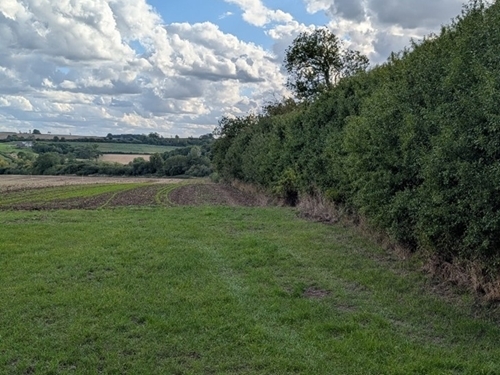
Hedgerows at Allerton
Allowing hedges to grow unmanaged may seem beneficial, but oversized hedges often lose their ecological and practical value. Tall, over‑mature hedges become thin at the base, reducing nesting habitat and cover for fledgelings. They can also shade out field margins, reduce crop yields and become unstable, increasing the risk of collapse. The life cycle of a hedge is a 25 to 30-year process of different stages of management, ultimately always resulting in rejuvenation. This creates hedges of different structures at different times across the farm, providing varying habitats for different bird species.
Rejuvenation techniques such as hedge‑laying and coppicing restore structure and vigour. Laying involves partially cutting stems and bending them over to create a thick, woven barrier that encourages new growth from the base. Coppicing cuts the hedge down to near ground level, prompting strong regrowth and a dense, bushy structure. Both methods effectively “reset” the hedge’s life cycle, ensuring it remains healthy and productive for decades. This winter we have rejuvenated nearly 1,500 metres of our hedges, mainly through traditional hedge laying with some coppicing.
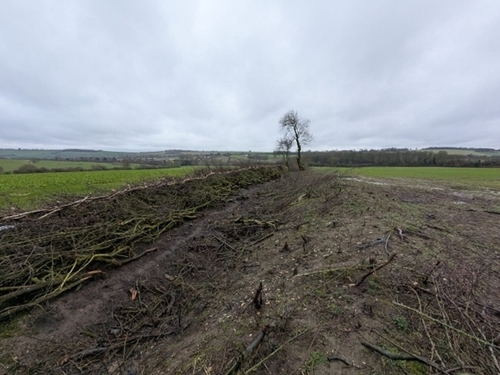
Laid hedge
Holloways Hedge
I’m increasingly thinking about how to make the most of available space. Growing up my father always told me, “Buy land, if you ever can as they aren’t going to make any more!” and he’s certainly not wrong. We only have so much space for nature and food production, which is making me think carefully about how I can improve all our existing habitat as opposed to just creating more.
This winter’s best example is Holloways hedge. It was almost entirely blackthorn, two metres high and very wide at five metres across, having grown over a ditch. I wanted to make more of this space, combining a hedge, ditch and field margin to form a rich mosaic of micro‑habitats. The hedge gives structure, shelter, and food, the ditch supports aquatic and damp‑loving species and the field margin provides wildflowers, early stage food for fledglings, grasses and open ground. Adjacent to this hedgerow is a winter bird seed mix. If managed as a single ecosystem, with three habitats within a continuous wildlife corridor, you can support more pollinators, more mammals and wider range of farmland birds, enhancing overall farm biodiversity. I believe this interconnected approach the key to establishing resilient, nature‑rich landscapes across the UK.
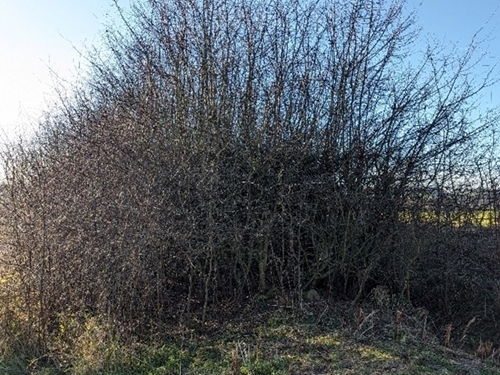
I’ve started by rejuvenating the hedge through a combination of traditional hedge laying and conservation laying. I can now clean the ditch out and check the drainage outlets. After that I will establish a flower rich margin alongside the laid hedgerow and manage it to improve flowering species and reduce the encroachment of blackthorn into the field.