Written by William Everitt, Placement Student
This overview summarises the updated carbon footprint assessment completed using the farm carbon toolkit for the Allerton Project’s farming operations for the season 2024/25. It highlights the main contributors to the farm’s low net emissions and explores future risks, particularly those linked to uncertainty around the Sustainable Farming Incentive (SFI) scheme.
The audit focuses on the carbon footprint of the farm and associated operations so that it remains comparable with similar farms, for this reason the visitor centre, shoot, and rental properties owned by the trust were excluded.
Farm Carbon Toolkit is considered accurate within current agricultural carbon accounting science; it uses detailed whole‑farm data and covers all emission categories, and includes sequestration (soil, trees, hedges), improving completeness. It is widely used in UK sustainability programmes and research networks as it aligns with IPCC standards and is moving toward SBTi FLAG and GHG Protocol alignment. It is also part of a Defra‑endorsed harmonisation programme with other carbon calculators including Cool Farm Tool and Agrecalc. Data was gathered from multiple sources, including Land App and Muddy Boots.
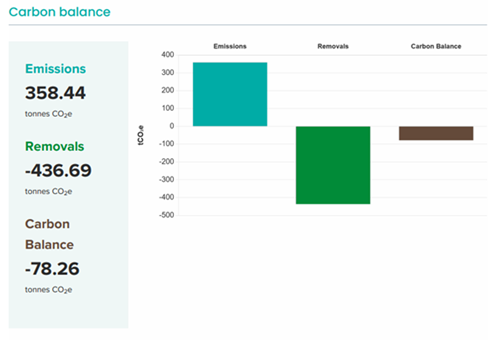
The Allerton Project’s 2024–25 carbon footprint shows a total of 358.44 tCO₂ein emissions and -436.69 tCO₂ein removals, giving a net carbon balance of -78.26 tCO₂e (figure 1).
- Total emissions: 358.44 tCO₂e
- Total sequestration: -436.69 tCO₂e
- Net carbon balance: -78.26tCO₂e
- Carbon balance per hectare: -0.25 tCO₂e/ha
- Fuel emissions per hectare: 0.28 tCO₂e/ha
- Agricultural crop yield: 1030.35 tonnes
Agrecalc — one of the three major UK carbon calculators with comparable methods with the Farm Carbon Toolkit — provides national benchmarking data for whole‑farm emissions. Its figures show that a typical, traditionally managed (non‑regenerative) arable or mixed farm in the UK emits around 3–5 tCO₂e per hectare per year, including emissions from fuel, fertiliser, cropping, livestock and minimal sequestration. Compared with this, the Allerton Project’s -0.25 tCO₂e/ha is exceptional.
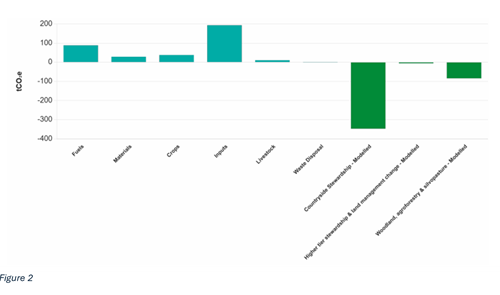
The largest source of emissions by far is inputs, totalling 235.33 tCO₂e, which accounts for 53.94% of all farm emissions (figure 2). This category includes fertilisers, pesticides, and other agronomic inputs with fertiliser production being particularly carbon intensive. In particular, liquid fertiliser Chafer Nuram 37 contributed 139.22 tCO₂e, representing 59% of all fertiliser-related emissions.
The next largest categories are:
- Fuels: 88.25 tCO₂e (24.62%)
- Materials: 28.53 tCO₂e (7.69%)
- Crops: 37.70 tCO₂e (10.52%)
- Livestock: 10.44 tCO₂e (2.91%)
- Waste disposal: 0.19 tCO₂e (0.05%)
Fuels includes the 11,700L of red diesel (contributing 39.57 tCO₂e), additional machinery fuel emissions (33.49 tCO₂e) from contracted operations (which were unusually high in 2024 due to a change of farm manager during spring planting and a large number of remedial cultivations), 2,000L of heating oil in the farmhouse, and 16,494kWh of average tariff electricity (contributing 6.44 tCO₂e), which is lower than it might be as electricity use is offset by the 200m2 of solar panels installed on the grain store roof.
Material usage was greater in the 24/5 season than might be expected due to the ongoing drainage scheme and fencing works around the farm. Twelve tonnes of various sizes of pipes, totalling 22.84tCO₂e, 564 tonnes of gravel, totalling 2.46tCO₂e, and 1,467 meters of stock fencing, totalling 3.23tCO₂e, was purchased.
Livestock was included in the assessment despite them only grazing seasonally. Sixty ewes contribute 10.44 tCO₂e.
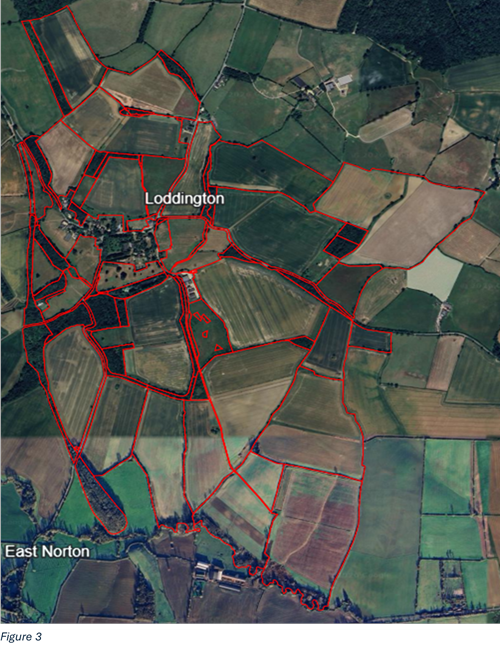
The Allerton Project maintains around 25% of the farm as non‑productive land managed for biodiversity and soil health this includes 19 hectares of woodland, 42 hectares of pasture and 24 hectares of other wildlife habitat (see figure 3). In 2024–25 these areas delivered -436.69tCO₂e of carbon sequestration in total almost entirely through environmental stewardship actions. Of the total removals:
- Countryside Stewardship – modelled: -347.12 tCO₂e (79.49%)
- Higher Tier stewardship & land management change: -5.46 tCO₂e (1.25%)
- Woodland, agroforestry & silvopasture: -84.11 tCO₂e (19.26%)
These figures clearly show that habitats such as margins, legume fallows, hedgerows, woodland, buffer strips and herb‑rich swards are doing the heavy lifting in delivering carbon removals across the project.
Notably high‑performing sequestration options include:
- GS4 Legume & herb‑rich swards: -120.99 tCO₂e
- AB8 Flower‑rich margins: -35.48 tCO₂e
- AB14 Low‑input cereals: -40.77 tCO₂e
- AB9 Winter bird food: -31.80 tCO₂e
- SW3 In‑field grass strips: -29.94 tCO₂e
Together, these results demonstrate that the Allerton Project’s low net emissions are not a product of low farming activity, but primarily of the substantial area of high‑quality habitat supported under stewardship schemes, which delivers significant, landscape‑scale carbon sequestration across the farm.
Many of the features contributing to the farm's low net emissions are supported—financially and structurally—by SFI or related environmental land management schemes. These schemes incentivise practices such as reduced cultivation, cover cropping, and maintaining wildlife habitats that sequester carbon and promote long-term soil health.
The UK government closed the Sustainable Farming Incentive (SFI) to new applicants in March 2025 after the scheme exceeded its annual budget allocation, creating uncertainty across the sector and pausing new agreements. Although DEFRA has now confirmed that SFI will continue, the scheme will reopen in stages from June 2026 under a revised structure and phased entry windows.
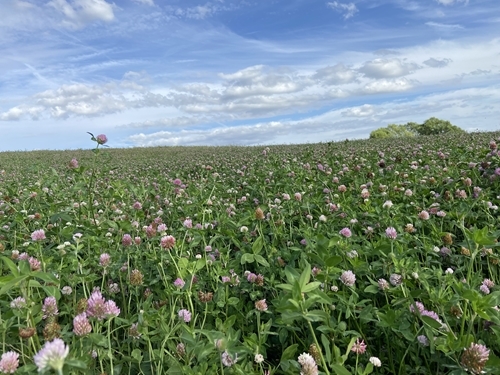
While DEFRA has described the updated SFI as “simpler, fairer and more stable,” the redesigned offer does see an overall agreement value cap (£100,000) and reductions in payment rates for some of the most popular measures (herbal ley, winter bird seed and legume fallow) which are also some of the key measures for carbon storage.
These reductions in ambition create financial risks for environmentally focused farms. If payment rates fall, land‑use limits tighten, or certain options are removed, the business case for maintaining environmentally beneficial farming may weaken, and farms may shift land back into more intensive production to remain financially viable. This would reduce carbon sequestration potential and increase net emissions—particularly where changes include:
- Returning fallow, legume fallow or AB‑series habitats to cropping
- Reducing grassland retention or overwinter cover
- Increasing cultivation intensity
- Cutting back on hedge, buffer, and margin expansion
Such changes would lead to higher soil carbon losses, increased fuel use, reduced biomass and soil sequestration, and lower landscape‑level carbon removals, ultimately driving the farm’s total emissions upward. If the SFI budget were reduced, the risk is not the sudden disappearance of environmental incentives but their diminishing scale, making the economics of long‑term habitat creation and carbon‑positive land management more fragile.
The long‑term objective of the Allerton Project is to enhance both the quality and connectivity of habitats across the farm, which will naturally increase carbon stocking density over time. New woodland corridors are being established to link a neighbouring SSSI and ancient woodland site with the watercourse at the far end of the farm, strengthening ecological networks and improving carbon capture. There are also plans to develop another agroforestry system in one of our largest fields. Introducing trees into this area will significantly increase carbon stocking density while delivering additional biodiversity and soil health benefits.
The Allerton Project’s low carbon footprint is driven by its extensive habitat management and regenerative practices, which deliver substantial sequestration and offset operational emissions. If SFI funding declines or eligibility tightens, maintaining large areas of non‑productive habitat may become harder to justify, increasing pressure to return more land to production and potentially raising net emissions, though it must be recognised that carbon intensity is only one of many competing elements of the decision making process on farms (and perhaps one which currently has little financial return)Ongoing policy monitoring, planning and prioritisation will therefore be essential to protect the farm’s current carbon gains.