Written by Henrietta Appleton, Policy Officer (England)
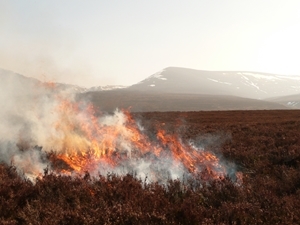 Yesterday (30 March) marks a year since the announcement of the consultation on extending the area covered by the heather and grass burning regulations. Stakeholder responses focused largely on the increased risk and severity of wildfires as a result. The new regulations came into effect on 30 September 2025 (midway through the Langdale Moor wildfire, which lasted from June to December 2025) and so it is worrying that during the Environmental Audit Committee session on peatlands Defra admitted that no licences to manage an increasing vegetation fuel load by prescribed burning had yet been awarded for wildfire or conservation purposes. With wildfires already happening this year (Scout Moor, Howden Moor, Dorset, Scotland) one has to ask when will Defra and its advisors, and indeed many of the eNGOs, accept that more needs to be done to mitigate wildfire risk and severity?
It seems that Defra has got itself into a bit of a corner. It accepted the eNGOs and NE evidence that prescribed fire was damaging to peatland causing carbon emissions in particular and so needed to be banned to protect the peat in pursuit of net zero (an argument that incidentally also met the eNGOs desire to ban grouse shooting by making the supporting management more difficult). In its launch of the new restrictions, Defra also promised that this regulation would reduce air pollution from prescribed fires, a statement that appears to have no actual data behind it whereas air pollution from wildfires is known to exceed WHO safety limits for prolonged periods of time over large areas.
It seems that at no point did any of these stakeholders consider what reducing vegetation management meant in terms of increasing the risk or severity of wildfire. It was also an easy win as Defra saw it. The emissions from upland peatlands are a fraction of those lost under agricultural peatlands, which make up most of our Grade 1 soils on which key aspects of our domestic food production rely, and so the economic impact of their rewetting would be greater. Now that wildfire is very much on the agenda, the argument that we need to rewet our upland peatlands for carbon sequestration is expanded to include wildfire mitigation and the avoidance of carbon losses. There are examples of reduced wildfire severity and even a fire front being stopped, but the complete suppression of a wildfire based on rewetting alone is not proven. In addition, the impact of rewetting on emissions of methane and nitrous oxide, both more potent GHGs than carbon dioxide, are also not known or being factored in.
Consequently, as the land management community has continually argued, we need all the tools in the toolbox – that means cutting, grazing, prescribed burning, restoration (all approaches) and public education (given that the majority of wildfire ignition sources are human related). Why?
There is strong evidence (both real and forecast) that climate change is increasing the risk of wildfire in the UK and increasing evidence that it will also affect peatland function to the extent that by 2061-2080 many English peatlands – even if restored by then – will cease to be net sinks as the climatic conditions needed to maintain year-round wetness will not exist. Given this, the reliance on rewetting alone begins to look risky. The strange thing is a Natural England commissioned review into three wildfires on its own deep-peat protected sites identified the need for additional wildfire mitigation measures during restoration and so fire control lines were adopted at Hatfield Moors for example. So why is this approach not being carried out more widely?
Then there is the evolving scientific context. In our Sustaining Ecosystems – English Grouse Moors review of 2022 we argued that rather than banning (and licensing) prescribed burning, government should encourage its evolution to meet environmental needs. Prescribed burning as a practice has already evolved in response to our understanding of the needs of moorland species and environmental outcomes. When we first wrote the Game Conservancy’s Red Grouse and Moorland Management green guide in 1995, the advice to create suitable habitat and provide fire breaks was to burn strips, ideally several hundreds of metres long and 20 metres wide and to remove the above ground vegetation but leave the rootstock unharmed, protected by the litter layer. Even then a successful, well managed fire would not have damaged the peat as is claimed.
Since then the evolution of the ‘cool’ burn has continued, such that research by Exeter University just published (see here) has shown that training in accordance with the Defra code of practice on heather burning results in underlying soils not being subjected to temperatures that would damage the carbon store (a more in-depth review of the research will follow). This proves that well-planned fire need not detract from delivery of net zero whilst also protecting against the more damaging impacts of wildfires to carbon stores by creating fire breaks or areas of reduced fuel load that allows suppression.
So, a year down the line from the consultation, whilst the policy approach has not changed, the evidence background continues to show that an adaptive management approach is necessary. When will Defra be bold and allow policy to catch up? Soon I hope, because that corner it is in looks particularly uncomfortable as the new wildfire season is already well underway.