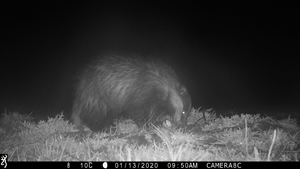
 New research suggests badgers are one of the main threats to the survival of red-listed ground-nesting birds including lapwing and curlew, and that the risk of nests being predated increased during cold or dry weather when their staple diet of earthworms is less accessible.
One study, a comprehensive review of camera trap data from across the UK, provides the clearest picture yet of which animals are responsible for nest predation in Britain. Of 2,088 nests included in the analysis 29.2% were predated. Wader nests were most often predated by mammals. Badgers were responsible for 41.7% of wader nest predation, followed by foxes at 23%.
Andrew Hoodless Director of Research at the GWCT, which contributed data to the study alongside other organisations including RSPB, Essex Wildlife Trust and Wildfowl and Wetlands Trust, said:
“Continued improvement and restoration of habitat is critical for wader conservation, but without predation management it can be in vain. This paper provides a valuable picture of the scale and nature of predation pressure across important bird breeding sites and will help inform management strategies for the protection of ground-nesting species. It also raises questions around how we tackle the threat from protected predators such as badgers. Non-lethal control methods, such as temporary electric fencing of nest sites, can be effective but are not always practical.
"Lapwing have declined by 53% with the loss of around 110,000 pairs in the UK since the mid-1990s, and there are now only estimated to be 300-450 pairs of nesting curlew south of Birmingham. Both species face local extinctions, whereas generalist predator populations have increased and are high relative to most other European countries. Given the urgent need to save some of our most iconic birds, some difficult choices might have to be made in future about licensing the control of certain species in particular circumstances, in order to protect others before it’s too late."
Data submitted to that study by the GWCT was from a six-year study of lapwing nests on the GWCT’s former demonstration farm Auchnerran in Aberdeenshire, which found that 1 in 4 nest predations were by badgers. Of the 372 nests analysed, 90 were predated and 23 of these by badgers. Weather emerged as a key driver. Badgers were more likely to take lapwing eggs during cold or dry spells, when earthworms (their staple prey) were less available at the soil surface. Dry or cold springs may therefore bring added pressure to already declining wader populations, particularly in areas where badgers and waders share grassland habitats.
Nick Hesford, GWCT Director Scotland, said: “The results of this long-term study show that, while foxes and corvids remain the most common nest predators UK-wide, badger predation can be a limiting factor on lapwing recovery in grassland habitats, especially in cold springs and where nesting sites are close to setts. The findings suggest that weather forecasting could inform targeted, pre-emptive predation management to help protect vulnerable wader populations, which will be essential if we are to reverse the continued decline of lapwing in Scotland.”
For summaries of both papers, visit:
Notes to editors
The Game & Wildlife Conservation Trust – providing research-led conservation for a thriving countryside. The GWCT is an independent wildlife conservation charity which has carried out scientific research into Britain’s game and wildlife since the 1930s. We advise farmers and landowners on improving wildlife habitats. We employ more than 60 post-doctoral scientists and other research staff with expertise in areas such as birds, insects, mammals, farming, fish and statistics. We undertake our own research as well as projects funded by contract and grant-aid from Government and private bodies. The Trust also has a dedicated professional advisory service to make sure that the results of its research are easily available to farmers, landowners, gamekeepers, and others delivering practical conservation.
For information, contact:
Eleanor Williams
Telephone: 07592 025476
Email: ewilliams@gwct.org.uk