Key points
- This study, part of the EU‑funded FRAMEwork project, investigated whether a small set of familiar farmland birds could reliably indicate wider bird diversity.
- Using Breeding Bird Survey–style data from 2021–2024 in Farmer Clusters in Cranborne Chase (England) and Buchan (Scotland), researchers tested which species best reflected both specialist farmland birds and the broader bird community.
- Linnet, Corn Bunting and Skylark were identified as indicators of specialist farmland birds in England.
- Linnet and Corn Bunting were identified as indicators of specialists farmland birds in Scotland.
- Linnet was the most consistent indicator across both countries .
- Goldfinch was identified as an indicator of the broader bird community (overall richness and abundance).
- This study shows that a small number of familiar farmland birds can give a reliable picture of how wider bird communities are doing.
- The results offer a practical, evidence‑based way for farmers and land managers to monitor biodiversity without needing expert bird identification skills.
Background
Traditional European farmed landscapes were once characterised by complex mosaics of low-input crops with hay meadows, hedgerows, and shrubs maintaining high levels of biodiversity. However, increased demands for food and animal fodder transformed many of these landscapes into intensely farmed, monocultural croplands.
This agricultural intensification has resulted in bird population declines across the board but particularly farmland specialist species due to their reliance on a landscape created through more traditional farming methods. This is deeply concerning as they are essential to the farmland functioning, contributing ecosystem services such as pest control and seed dispersal. Corn Buntings and Lapwings are among the species that have been hit especially hard. As a result, numerous government Agri-Environment Schemes have targeted conservation measures such as field margins or cover crops.
Monitoring farmland birds is essential for understanding wildlife dynamics on farms and how we can better support them. Bird monitoring initiatives have been running since at least the 1960s, and today over 15,000 volunteer birdwatchers take part in national‑level monitoring schemes across Europe. However, most bird surveys require identifying many species by sight and, more often, by sound. This usually requires expert ornithologists to create accurate and valuable datasets. Increasingly, farmers, land managers and other practitioners want to monitor their land but are not always expert birdwatchers.
This study explored whether a small number of easily recognisable bird species could act as indicators of wider farmland bird diversity. If certain species reliably reflect the abundance or richness of specialist farmland birds, or of the whole bird community, then practitioners could focus efforts on a few species, making monitoring a much easier learning curve while still providing meaningful insights into the health of their farmland.
What they did
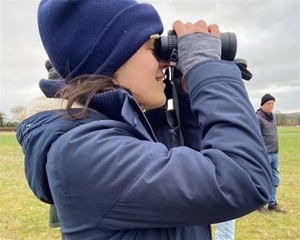 This study used breeding bird survey data from the FRAMEwork project to identify which farmland bird species could act as useful indicators of bird diversity on lowland mixed farmland. The data was collected between 2021 and 2024 from two Farmer Clusters: one in Cranborne Chase, England, and one in Buchan, Scotland.
The aim was to find a small number of species whose abundance reliably reflected the abundance or richness of both specialist farmland birds, a group that has declined sharply since the 1970s and is a major focus of habitat management on UK farms; and the wider farmland bird community. Because Farmer Clusters often rely on practitioner‑led monitoring, identifying simple, reliable indicator species would help surveyors understand how counts of individual species relate to the wider bird community.
The researchers expected that:
- England and Scotland will share similar indicator species, because both landscapes are dominated by arable farming and support many of the same specialist species (e.g. Skylark, Yellowhammer).
- The best indicators of specialist farmland birds will be species that depend heavily on traditional farmland habitats. These species should correlate strongly with specialist bird abundance and richness, but less so with the wider bird community.
- Other species will act as indicators of overall bird diversity, reflecting total abundance and richness rather than specialist species alone.
- Species most strongly linked to specialist bird groups will be those known to respond to farmland habitat management.
Both study areas were dominated by arable farming, with the English Cluster covering a large, continuous block of nineteen farms and the Scottish Cluster made up of eight separate farms. Each had implemented habitat management beneficial to birds, such as hedgerow planting, flower strips, winter bird food mixes, and, in Scotland, minimum tillage and cover crops, as part of the wider FRAMEwork project on landscape‑scale biodiversity. To ensure surveys fairly represented these landscapes, the team selected one‑kilometre squares that were mostly farmland, placing one square on each Scottish farm and using a grid‑based approach in England. They also checked that habitat types were broadly comparable between regions so that differences in bird communities were not simply due to land‑cover variation.
Birds were surveyed using a standardised method adapted from the British Trust for Ornithology’s Breeding Bird Survey. Observers walked one‑kilometre transects twice each breeding season, recording all birds seen or heard and noting distance, behaviour and weather to ensure consistency across farms and years. The study focused on twelve specialist farmland species, including Corn Bunting, Skylark, Linnet, Yellowhammer, Grey Partridge and Lapwing. The researchers compared bird communities between England and Scotland, examined how individual species related to wider patterns of abundance and richness, and tested whether particular species could act as reliable indicators. They then repeated the analysis using 2024 data to confirm the robustness of their findings.
What they found
 Across the two Farmer Clusters, the surveys recorded tens of thousands of birds and revealed clear differences between the English and Scottish sites. England had higher overall bird numbers, dominated by common generalist species such as Woodpigeon and Rook. Scotland had a more even mix of species, with Skylark and Starling the most frequently recorded. Despite these differences, both clusters showed similar levels of species richness, with around 22 bird species and six specialist farmland species recorded per survey.
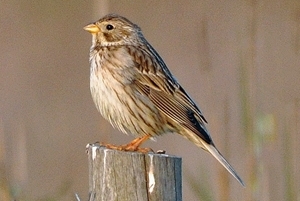
Although both areas supported many of the same farmland specialists, the overall bird communities were distinct enough that each region needed to be analysed separately. This meant that the best indicator species were not identical in England and Scotland. In English farmland, Corn Bunting, Linnet and Skylark were most strongly linked with the abundance and richness of specialist farmland birds, with Linnet showing the most consistent associations across all measures. In Scotland, Linnet again emerged as the most reliable indicator of specialist farmland birds, with Corn Bunting also performing well.
When looking at the broader bird community, Goldfinch corresponded best with overall richness and abundance in both Scotland and England. This means that spotting Goldfinches on farmland is a good sign of a healthy and diverse general bird community.
These findings were tested using new data collected in 2024, and the same patterns largely held true. In England, all proposed indicator species continued to reflect wider bird abundance. In Scotland, Linnet and Corn Bunting again tracked specialist species well, and Goldfinch showed a positive, though not statistically strong, relationship with total bird abundance.
What this means
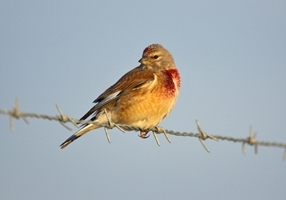 This study shows that a small number of familiar farmland birds can give a reliable picture of how wider bird communities are doing, but it also highlights that indicator species need to be chosen carefully and with clear goals in mind. For farmers and land managers interested in the health of specialist farmland birds, species such as Corn Bunting, Linnet and Skylark proved to be the most useful indicators. For those wanting a sense of overall bird diversity, species like Goldfinch, and in England, Stock Dove, were better indicators. These indicator species are also relatively easy to recognise, making them accessible for practitioners who may not have advanced bird identification skills.
The study also shows that despite expectations, indicator species do not quite work the same way everywhere. Bird communities in England and Scotland differed enough that the best indicators were not identical between regions. Some species behaved differently in each landscape, meaning they cannot be used as universal indicators. Species that were rare or absent in this study, such as Lapwing, may still be valuable indicators in other areas where they remain more common.
Overall, this research provides a strong starting point for farmer‑led monitoring. By focusing on a small set of easily recognisable species, Farmer Clusters can gather meaningful biodiversity information without needing expert birdwatching skills. With further testing and refinement, this approach could support citizen‑science monitoring, help evaluate agri‑environment schemes, and provide a practical evidence base for improving farmland management and supporting nature recovery.
Read the original abstract
N. M. McHugh, E. R. Ness, R. Nichols, G. Banks, D. Strong, M. W. Young, A. Zuta, G. S. Begg (2025) Identification of Farmland Bird Indicator Species for Practitioner Monitoring in the United Kingdom, Ecology and Evolution