Key points:
- Optimal seabed characteristics are essential for the survival of juvenile fish such as cod, haddock and whiting.
- Researchers investigated which habitat features determined the distribution of these species around the Forth of Clyde using nearly 500 underwater video deployments.
- They found that juvenile cod, haddock and whiting were all strongly associated with areas of higher seabed biodiversity.
- Cod concentrated in shallow, algae‑rich areas, haddock in deeper, sheltered waters, and whiting forming a ring around the island at depth, particularly near algal patch edges.
- These findings underline the need for year‑round protection of sensitive habitats which account for how juvenile fish use the landscape.
Background
Healthy fish populations depend on the survival of their youngest life stages, and for many species this means having access to the right nursery habitats. For fish such as cod, haddock and whiting, the seabed they settle onto as juveniles can strongly influence whether they survive to adulthood. These early stages rely on a mix of habitats that offer food, shelter and protection from predators, and even small changes in habitat quality can affect recruitment into the adult population.
Across coastal waters, complex seabed features such as seagrass, maerl beds (coral-like, red seaweed) and kelp forests tend to support higher biodiversity. These richer, more structurally varied habitats provide better feeding opportunities and refuge for young fish. However, many of these habitats are vulnerable to disturbance. Bottom‑towed fishing gear, for example, can reduce biodiversity and alter the structure of seabed communities, with long recovery times once the pressure is removed. This means that protecting nursery habitats year‑round (not just seasonally) may be important for rebuilding depleted stocks.
In Scotland’s Firth of Clyde, decades of heavy fishing have reshaped the marine ecosystem. Once home to a diverse fish community, the Clyde has seen declines in many species and a shift towards a few dominant ones. Cod, haddock and whiting have all experienced long‑term population changes, and despite management measures, these stocks are still not performing at their potential. Understanding exactly which habitats young gadoids depend on, and how these habitats are arranged across the seascape, is therefore essential for designing effective spatial protection.
What the researchers did
The team set out to identify which habitat features best explain where juvenile cod, haddock and whiting are found in the Firth of Clyde. They focused on the waters around the Isle of Arran, including the South Arran Marine Protected Area, which contains a mix of protected features and areas still open to fishing.
To do this, they used stereo-baited remote underwater video (SBRUV) systems, paired with underwater cameras that record fish attracted to a bait source. These were deployed at randomly selected sites during 2013, 2014, 2018 and 2019, covering a range of depths and seabed types. The cameras allowed the researchers to confirm the presence of juvenile fish and accurately measure their size, while additional substrate analysis drew on extensive drop-down video (DDV) data provided by NatureScot to characterise the seabed in more detail.
At each site, they also recorded a suite of environmental variables, including:
- Seabed type (mud, sand, gravel/maerl, pebble, algae)
- Patch size and shape
- Distance to the edge of habitat patches
- Depth and distance from shore
- Current speed
- Seabed ruggedness
- Local biodiversity (based on epibenthic and demersal species)
Using these data, the researchers built statistical models to test which habitat features best predicted the presence of each species. They also examined spatial patterns and accounted for differences among zones within the MPA. Finally, they used the models to map predicted nursery habitat across the wider area, highlighting where conditions are most suitable for juvenile gadoids.
What they found
Across 488 valid underwater video deployments, the researchers found that juvenile cod, haddock and whiting were all strongly associated with areas of higher seabed biodiversity. This was the only factor shared across all three species, highlighting the importance of rich, complex habitats for young gadoids.
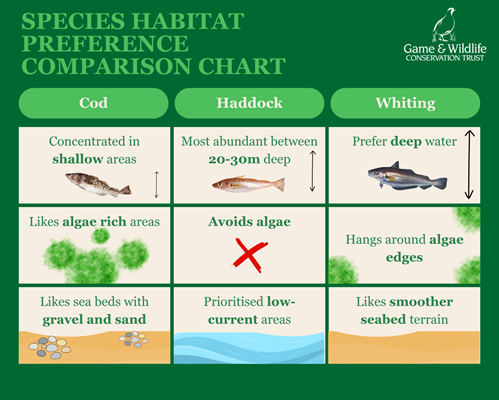
Beyond this common pattern, each species showed its own habitat preferences:
- Cod were most likely to be found where algae, gravel and sand were present, especially around the edges of sand and mud patches. They tended to use areas that offered both feeding opportunities and places to hide, reflecting their reliance on camouflage and refuge during early life stages.
- Haddock were strongly influenced by depth, with presence peaking between 20–30 m, and were more common in deeper, low‑current areas close to shore. This apparent proximity to shore is likely influenced by local bathymetry around Arran, and in other studies haddock are more typically associated with deeper offshore waters. They avoided areas with high algal cover.
- Whiting preferred deeper water with smoother seabed terrain, and were most likely to be found just outside the edges of algal patches, not inside them. This boundary zone appears to offer good foraging opportunities, including access to smaller fish such as juvenile cod.
Mapping these patterns showed clear spatial differences around the Isle of Arran. Cod concentrated in shallow, algae‑rich areas, haddock in deeper, sheltered waters, and whiting forming a ring around the island at depth, particularly near algal patch edges.
Together, the results show that habitat mosaics and patch boundaries, not just the presence of a single habitat type, play a major role in shaping where juvenile gadoids settle and survive.
What this means
The study provides strong evidence that protecting whole seascapes, rather than isolated features, is essential for supporting juvenile fish. Because young cod, haddock, and whiting rely on a mix of habitats, especially at the boundaries between them, management approaches that focus on single features (such as maerl beds or seagrass alone) risk missing the wider ecological context these species depend on.
Areas with a richer variety of sea‑life inhabiting areas on and close to the seabed consistently supported more young fish. This shows that protecting and restoring marine biodiversity is essential for helping depleted fish populations recover. Many juveniles gathered along the boundaries between different habitat types, using these areas for feeding or shelter. Because these edges are easily damaged by fishing gear that drags along the seafloor, keeping them safe is especially important.
Whole‑site protection is more effective than feature‑based designations. Because nursery habitat depends on the arrangement and connectivity of multiple seabed types, management that safeguards the entire seascape, rather than only specific features, is more likely to support recruitment and long‑term stock recovery.
For the Firth of Clyde, where decades of fishing have reduced both biodiversity and fish community complexity, these findings underline the need for year‑round protection of sensitive habitats and broader spatial measures that account for how juvenile fish actually use the landscape.
Seascape ecology of juvenile gadoid nursery areas | Royal Society Open Science | The Royal Society
A novel use of Stereo Baited Remote Underwater Video and Drop-Down Video for biodiversity and marine landscape mapping and prediction | PLOS One