Tracks are captured in perfect detail on rafts and mink tracks are easily recognised (see below). A field guide on animal tracks will help you distinguish other species if you are in doubt. We have also compiled a photographic guide to mink and other tracks that you may find helpful. The tracks most similar to mink are those of polecats, and at present we can offer no reliable rule to distinguish the two species from their tracks. Polecats do visit rafts, but not frequently.
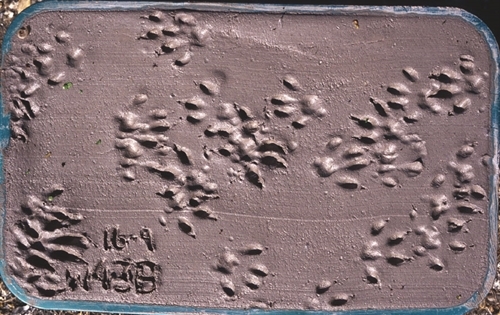
Tracks of other species, for instance water voles and water shrews, may also be of interest. Note that water vole tracks are often impossible to distinguish from those of brown rats. Only where droppings are also present can you be completely sure which of the two species was involved. Water voles often use the rafts as latrines, leaving droppings on the raft base, tunnel and tracking cartridge.
Switching to trapping mode
When adding a trap to the raft the tracking cartridge is removed. The cartridge and clay can often be stored somewhere close at hand after wrapping it in a plastic bag to keep it wet. If you leave it in place, it will probably be fouled by the captured animal.
For live-capture traps it is usually simply a matter of sliding the trap into the tunnel. If the tunnel is closely dimensioned to suit your live-capture trap, you may need to remove or loosen it to slide the trap in. When tightened down, it will clamp the trap to the raft, which helps to prevent theft. Small brackets or short lengths of galvanised steel builders’ band can also be used to secure the trap to the raft with screws.
Trap monitoring
While it is a slight legal grey area, the GWCT’s interpretation of the Animal Welfare Act 2006 is that when a trap is set it must be checked every day so that captives can be dealt with quickly. This will apply especially to any captives held alive in a cage trap.
Over the last few years, we have been hearing of an increasing trend to use trap monitoring devices that send a message to the operator when the trap goes off. We accept that this gives scope to get to a trap more quickly when it is sprung. However, we are concerned that any tendency to unreliability could leave a trapper relying on such alarms liable to prosecution in the event of a breakdown if the message does not get through.
There is also a growing trend to use what are being called ‘smart rafts’, where the trap is permanently set, and relies on an alarm to say when it has been triggered. This can seem like an attractive idea in that there is no time lag between detection and capture, however, it fails to recognise the fundamental reason for the raft in the first place, which was about detecting mink presence. If there is no mink out there a raft used in this way can only catch non-target animals.
In our view this is an irresponsible approach, in that it puts non-target animals at much higher risk of being caught. Aside from the welfare implications of being captive, it should be remembered that not all animals caught in a cage trap are unharmed. Some will be injured, and a small number may even die. Also, under the Wildlife and Countryside Act, 1981, some of the non-targets, such as water voles, may not be deliberately trapped, leaving the trap user open to possible prosecution for recklessness. Some manufacturers offer water vole excluders with a view to addressing this, and while we are assured that they work, we know of no proper scientific investigation to prove this, nor to show that they do not deter mink.
The GWCT recommends that all rafts are reverted to monitoring mode as soon as a mink capture is made. This minimises non-target risk, and it was this approach that led to the UFAW Wild Animal Welfare Award mentioned in the introduction.
Get your FREE Mink Raft Plans today
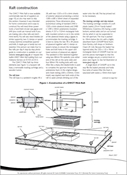 The award-winning GWCT Mink Raft was developed both as a means of detecting mink, and as a favourable trap site.
What you can download for free
✓ Mink Raft Guidelines
✓ Instructions & Plans
✓ How to Build the GWCT Mink Raft
Download now >