By Joe Stanley, Head of Sustainable Farming, Allerton Project
As Defra gathers evidence on the impacts of gamebird rearing, release and shooting in England, it is essential that the discussion is informed by real-world examples from working landscapes. The current call for evidence explicitly seeks information on both the positive and negative impacts of gamebird management on biodiversity, habitats and rural communities.
At the GWCT Allerton Project, we have spent more than three decades demonstrating how productive farming and environmental improvement can go hand in hand. One of the clearest examples of this is our approach to game management, which has consistently delivered benefits far beyond pheasants.
I often describe successful game management as a three-legged stool. Remove any one leg and the whole thing becomes unstable.
The first leg is habitat management. The second is predator management. The third is supplementary feeding. Taken together, they form the basic tenets of ‘keepering’ and support healthy game populations, but crucially they also create conditions that allow a wide range of farmland wildlife to thrive.
Too often, debates around game shooting focus solely on the birds being released or shot, often with a strong political undertone belying the lack of understanding of the activity. In reality, good game management is fundamentally about land management.
Across the Allerton Project, habitat creation associated with game conservation has resulted in a rich mosaic of woodland edges, conservation headlands, grass margins, pollen and nectar plots, wild bird seed mixes, hedgerows and cover crops which did not exist on our farm before the introduction of a shooting interest in the early 1990s. These habitats provide nesting opportunities, shelter and food resources for a huge variety of species throughout the year.
The benefits are visible in our long-term monitoring. Songbirds, pollinators, small mammals and many other farmland species make use of habitat established originally with game management objectives in mind. Importantly, these habitats provide resources at times of the year when food can be scarce within intensively managed agricultural landscapes.
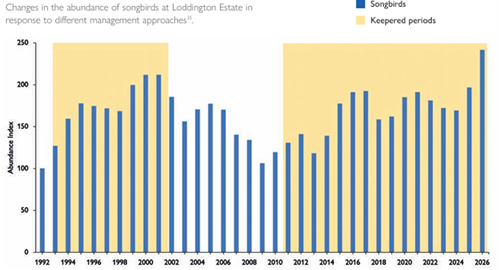
The impact of keepering for game at the Allerton Project for songbird numbers. 2002-2010 saw both predation control and supplementary feeding removed.
The second leg of the stool, legal predator management, is perhaps the most controversial but also one of the most scientifically studied elements of game conservation. Ground-nesting birds face significant pressures from generalist predators. Numerous research projects, many of them conducted by the GWCT, have demonstrated that carefully targeted predator control can improve breeding success for species such as grey partridge, lapwing and curlew.
At the Allerton Project, predator management is not undertaken simply to protect pheasant numbers. It forms part of a wider strategy to restore ecological balance and improve nesting success for vulnerable farmland birds and other species such as brown hare. The evidence from across the UK repeatedly shows that where habitat improvement and predator management work together, conservation outcomes are often considerably stronger than when habitat enhancement is undertaken alone.
The third leg, supplementary feeding, is similarly undervalued. While feed is provided primarily to support game populations during difficult periods, the benefits frequently extend much further. Spilled grain, winter bird seed mixes and managed feeding areas support a wide range of seed-eating birds through the winter months, helping species survive the new year ‘hungry gap’ when natural food supplies are limited. Indeed, many farms and estates – like Allerton – provide songbird-specific feeders to support non-game species as a normal part of our good stewardship around the shoot.
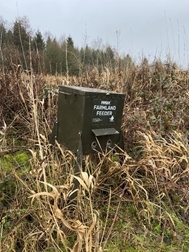 A new Perdix squirrel-proof farmland bird feeder at the Allerton Project
What makes the three-legged stool concept so powerful is that each element reinforces the others. Habitat provides nesting sites and food. Predator management improves survival and breeding success. Supplementary feeding helps sustain populations through critical bottlenecks. Together they create resilience within the wider ecosystem. This integrated approach helps explain why many of the UK's remaining strongholds for certain declining farmland birds are associated with landscapes where active game management takes place.
Of course a key point to make is that game management contributes some £500m/year across 14m days of work in conservation activity funded by private sources across the UK New report reveals benefits to biodiversity of gamebird releasing - Game and Wildlife Conservation Trust. Given the increasingly parlous state of ‘public money for public goods’ in England, that is tangible conservation activity which would likely not be funded from any other source.
That is not to suggest game management is beyond scrutiny. Nor should any land-use activity be exempt from evidence-based assessment. Defra's call for evidence is therefore welcome if it results in an objective examination of the full range of environmental outcomes associated with game management and shooting.
However, it is vital that policymakers recognise what can be lost if game management disappears. The habitats, conservation investment and on-the-ground management effort that support gamebirds frequently underpin much broader biodiversity benefits. In many cases, it is the economic incentive provided by shooting that funds these conservation activities at a landscape scale.
At the Allerton Project, we view game management not as an isolated activity but as part of a wider commitment to sustainable land stewardship. Our experience demonstrates that when habitat management, predator management and supplementary feeding are applied responsibly, the result is a healthier, more diverse countryside.
As Defra considers the evidence before it, I would encourage decision-makers to look closely at those landscapes where wildlife is genuinely flourishing. In many cases, they will find that the three-legged stool of game management is helping to support far more than gamebirds alone. It is supporting the wider biodiversity that society increasingly values and that our farmed landscapes urgently need.