By Jobe Burnham, Conservation Officer, Allerton Project
 The day spent on the recent SFI 2026 application window was almost certainly the most stressful, frustrating and ultimately devasting I have ever worked. The disappointment when I told my colleagues, directors and trustees that we didn’t get in was heartbreaking. We spent weeks planning the application. A scheme on a 320-hectare farm isn’t a pick-and-mix-chuck-it-together approach, but a carefully constructed plan, aimed at delivering the best environmental benefits we can achieve through nature recovery, improved soils and managing water, while still producing high-quality food sustainably.
Those weeks of planning turned out to be in vain, and planning is a vital part of any business particularly in agriculture with crop rotations, seed orders, livestock decisions and labour arrangements often needing to be agreed many months in advance. Therefore, the SFI has failed farmers and the system must change. Even if you were one of the 12,200 successful applicants, if the process remains the same, you’ve roughly a 30% chance of getting into the scheme next time. Can you afford to build a business around a statistic smaller than the chance of guessing the outcome of flipping a coin?
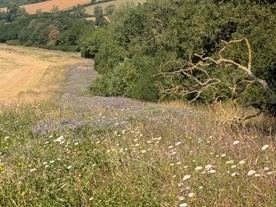
How does this affect nature? Many farmers will be left wondering do I keep the habitats around the farm? Can I afford to maintain them? Or do I remove them and hope that wheat prices increase? If they decide it’s not worth the risk and look to replace land set aside for nature with food production, it will have an instant negative impact on wildlife. If we were to remove the habitats currently in our Mid-tier agreement, ending Dec 2026, such as winter bird seed mixes or pollen and nectar mixes, this would result in a loss of over 20 hectares of habitat. As our evidence shows, bird seed mixes are vital for song bird populations, likewise the pollen and nectar mixes spread across the farm are vital for invertebrates and pollinators. Similarly, if were to remove field margins, not only the habitat would be lost but neighbouring water courses would be negatively impact as a result. The flower rich margins are particularly sensitive and are not a habitat that once removed could be easily replaced. They have been managed over many years, removing cuttings to reduce nutrification, suppressing grasses and encouraging species diversity (see picture below).
Landscape-scale change is the best approach to achieving environmental goals, and it’s far easier to undo progress than to make it. If the SFI scheme can no longer meet demand, a much smaller proportion of land will benefit. If I farm as sustainability as I can and my two neighbours farm as intensively as possible, not necessarily through choice, but simply to try make their business succeed, we lose the landscape scale connectivity that nature needs to thrive.
Moreover, seen in the bigger picture context of the Farming Road Map 2050, it seems in the long term the Government’s plan is for public funding to be gradually withdrawn to be replaced by private sector investment. The problem is at present there is little sign of that materialising and nature can’t just be turned back on like a tap if funds ever appear. If habitats are removed and wildlife disappears, it takes far longer and costs much more to restore it. As on many farms, the impressive biodiversity gains at the Allerton Project have been accumulated over time thanks to decades of public funding investment via agri-environment schemes and dedicated work on the ground by those implementing the measures. All that taxpayer investment and personal effort could be wasted, if there is a funding gap.
In my view, SFI isn’t supporting farmers and land managers nor nature in the way it could, or was intended to, and therefore it needs to change as soon as possible. The answer is we need more money in the pot, which is a perfectly reasonable request. Concerns were raised pre SFI 26 release that there simply wasn’t enough to go round, which was confirmed last week. My concern, is even if the government finds more money, will it be enough in the long term? If the pot doubles, would 60% of farmers get in? Does that not leave the remaining 40% in even more of a deficit than the 60% who didn’t get in this time?
I believe that all farmers should have the opportunity to access Environmental Land Management Schemes (ELMS), and everyone should be encouraged to apply. We need system where money is distributed more fairly and effectively and no-one is simply shut out like we were at the Allerton Project. It is certain that the scheme must change, DEFRA is apparently “exploring alternatives” so we have some hope. I hope we do not see a repeat of this year’s catastrophe!