By Joe Stanley, Head of Sustainable Farming, GWCT Allerton Project
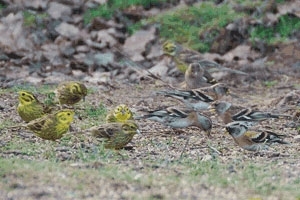 The most recent release of Defra’s Wild Bird statistics this week shows that long-term declines in almost all habitats dating back to at least the 1970s continues, with the most significant downward trend impacting farmland birds - a 66% decline in England over that time, with a 12% decline since 2020 alone.
The long-term reasons for this fall are well understood and can largely be attributed to changing farming practices since the Second World War as society directed farmers to produce ever-more food for ever-less return in that period.
However, these generalised declines are not universal, and on farms across the country localised success stories are increasingly common. Not least of these can be discovered at the Allerton Project, a 320-ha mixed research and demonstration farm in Leicestershire and flagship site of the Game & Wildlife Conservation Trust. After taking over management of the farm in 1992, nature-friendly farming measures saw farmland bird numbers increase by 75% within three years and more than 100% within seven. This year saw our highest levels of farmland birds yet, with numbers 145% above 1992 levels.
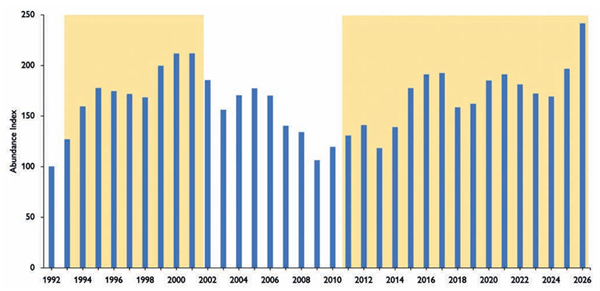
Fig 1: Farmland bird numbers at the Allerton Project: the orange shading indicates nature-friendly farming measures being implemented. The white indicates their intentional removal.
The reasons for this success story are no secret and are less complex than might be imagined. The simple provision of suitable, high-quality habitat, supplementary winter feeding and the management of excessive predator populations form the ‘three-legged stool’ approach to our success. Indeed, having implemented this approach from 1993 and seen its success over a decade, we withdrew predator control in 2002 and supplementary feeding in 2007 to observe the impact, before restoring all three elements in 2011. As can be seen from the chart in Figure 1, the results speak for themselves.
Many of these measures have, for a long time, been paid for under successive agri-environmental schemes under both the EU’s Common Agricultural Policy (CAP) and the post-Brexit Sustainable Farming Incentive (SFI) and wider Environmental Land Management (ELM) schemes. Indeed, many of the practices pioneered at the Allerton Project were adopted into those programmes. Why, then, do we continue to see generalised declines in farmland bird numbers? Are eNGO commentators right to say that the current approach simply isn’t working and we need to take ever-more farmland out of production to meet our environmental goals?
Our answer is no; fundamentally, this is a question of scale and commitment. The Allerton Project is and always has been a commercial farm; our nature-friendly farming methods see food production exist alongside an increasingly thriving natural environment. The problem is that at no point has the budget allocated to such methods been sufficient to the scale of the challenge. Inside the EU, only a fraction of the CAP budget was allocated to such voluntary measures. Post-Brexit, the government has made much of the switch toward paying farmers public money solely for environmental outcomes, but the recent farce which saw the SFI application window open for a mere 352 minutes before the budget was exhausted – leaving some 70% of eligible farmers disappointed – merely highlighted the lack of cash allocated by Treasury versus the purported ambition signalled by successive governments.
These new farmland bird statistics will no doubt generate yet another round of hand-wringing from commentators and ministers, with calls that ‘something must be done’. Yes, it must. Government must acknowledge that the answers sit before it, that genuine political will must be put behind them, and the budget must be made available to enable farmers to deliver the action we need to see and they wish to deliver. As can be seen from the experience of the Allerton Project; if this were done today, we could reverse the downward trend of farmland birds – and much else – by the end of this decade. We need no more studies; no more reports; no more inquiries; give farmers the means, and we will deliver the results.