By Mike Swan, Senior Advisor
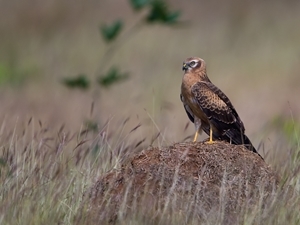 A BBC News report from last week rightly celebrates the good news that two broods of three Montagu’s harriers have successfully fledged at a “secret location” in the south of England. Apparently, both broods were fathered by the same male, who has therefore done very well to find enough prey to feed two wives and six young. He is certainly a success story: having been hatched and ringed in 2016, he also successfully fathered a single brood of four at the same location last year.
We are told that these young Montagu’s harriers are the first to have been produced in the UK since 2019. In common with other harriers, they nest on the ground, in their case often choosing sites in cereal fields, where they are vulnerable to the likes of foxes and crows, just like gamebirds. So, congratulations to the RSPB, and to the farmers who have hosted them, for collaborating to protect and monitor these wonderful birds.
They are named after the famous ornithologist, George Montagu, who discovered that a few were breeding in southern England a couple of centuries ago. The smallest of our harriers, they are remarkable birds in many ways, with the elegant grey males and brown females having a wonderful buoyant flight as they quarter low and slow over their hunting grounds. Their diet is very mixed, and includes small mammals, birds, reptiles and large insects. They are also long distance migrants, travelling thousands of miles each year, with our western birds journeying to sub-Saharan Africa to winter.
Their appearances in Britain have always been sporadic, with breeding numbers fluctuating considerably, but they have always been one of our rarest birds of prey. However, I raised my eyebrows when I read a quote from Mark Thomas of RSPB that they are a “species on the brink”.
The truth is that we do not have a British ‘population’ on the brink and at risk of extinction, rather we are at the very edge of the range of a highly migratory and widespread European and Asian breeding species that is recognised as ‘least concern’ in international terms. It is a joy to know that they have bred successfully again, and I am one of the many who considers it a red-letter day when I spot one in my south of England home patch, but please let’s not exaggerate their importance. The odd birds that visit and breed with us are insignificant in overall population terms, no matter how much we treasure having them here.
I also wonder about another small part of the story that was picked up by the BBC: the assertion that climate change is not helping them. 2026 has been a quite exceptional summer, and Mark Thomas may be right that the unprecedented early harvest could have put unfledged nests at risk. But, bearing in mind that we are at the northwestern limit of their breeding distribution, it seems to me that we might expect Montagu’s harriers to spread north in response to a warming world, hopefully resulting in more of them breeding with us, and not less.
The UK Montagu’s harrier story also highlights a wider challenge in conservation: the status of a species can look very different depending on the scale at which it is viewed. Woodcock, for example, are red-listed in the UK because of concerns about the decline in breeding numbers, despite remaining relatively secure globally, with no sign of a significant decline in our wintering populations. Equally, there are species such as curlew for which Britain carries a particularly heavy responsibility because a substantial proportion of the declining world population breeds here.
Seen in that context, Montagu’s harrier occupies a rather unusual place. It is undoubtedly one of our most exciting and scarce breeding birds, but its significance lies more in what its occasional nesting attempts tell us about range expansion, migration and habitat conditions than in any contribution Britain makes to the species’ overall conservation status. Recognising distinctions like this should help us direct limited conservation resources to where they can achieve the greatest benefit.
Photo by Cks3976, licensed under CC BY-SA 3.0