By Holly Appleby, Philip Warren & Adriana Dermetzis, Uplands Research Team.
In northern England, black grouse are found on the moor fringe, where females, also known as greyhens, nest and rear their chicks. Here, they typically live along time, but population recovery is limited by poor breeding productivity. Thus, to increase numbers, we need to improve this. The critical period for chick survival is the first three weeks after hatching in June. Poor chick survival in this period can be linked to a combination of factors including poor weather, habitat quality, predation and food availability. Greyhens are also sensitive to disturbance, often leaving their broods unattended if disturbed, making studying them challenging during this critical period.
To study their movements and behaviour we started to monitor birds remotely using GPS tags in 2024. These solar powered tags record and transmit a bird’s location in real time at programmed intervals throughout the day and night. This allows fine scale movements to be studied from afar. Catching and tagging birds has involved roaming their roosting habitats on the moorland edge over long, cold dark nights; not always a pleasant experience but definitely a rewarding one. Over the past two breeding seasons we have deployed a total of 24 GPS tags, with a further ten females caught and tagged this spring.
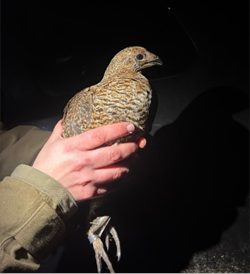
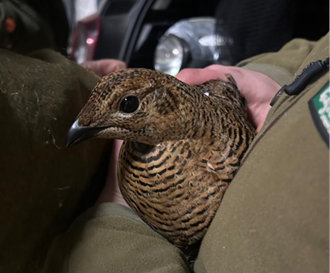
The GPS tags allow us to identify nest sites, start of incubation, hatch date, brood foraging and roosting locations, and calculate brood home ranges. We will use this information to investigate how brood habitat use and brood survival relate to insect abundance, sward height, structure and composition. Data have been collected over two very different breeding seasons, with 2024 a very poor year, where all tagged females failed to rear chicks, in stark comparison to 2025, which was an excellent year where two thirds of tagged females reared chicks. We will collect further data this summer and then assess the findings to help inform grazing regimes to create the desired brood-rearing habitats in rough grasslands on the moorland fringe.
Deployment of these tags and subsequent monitoring would not have been possible without funding from Natural England’s Species Recovery Programme, Farming in Protected Landscapes, BASC Wildlife Fund, or without the help from the local gamekeepers who have been fantastic at helping us to locate female black grouse for this study.