Key points
- Upper Teesdale supports around 1,764 breeding pairs of curlews, equivalent to approximately 3% of the UK breeding population.
- Curlew numbers remained broadly stable over a decade despite substantial national declines.
- Curlews produced around 1.0 fledglings per pair, almost double the level needed to maintain stable numbers.
- Blanket bog managed for red grouse shooting supported more than twice as many curlews as unmanaged blanket bog.
- High curlew numbers and breeding success were associated with connected open-ground upland habitats in designated protected landscapes, where legal predator control and blanket bog management for red grouse shooting, together with wildlife-friendly farming, were widely practised.
Background
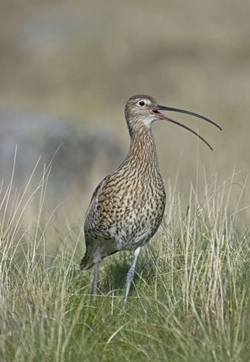 Curlews are one of the UK’s most rapidly declining waders. Nationally, their population has fallen by 49% between 1995 and 2021, and breeding success in many lowland areas is now so low that numbers cannot sustain themselves. The scale of the challenge is stark. Across 21 previous studies, more than half of curlew nests were lost to predation in 71% of cases, while many sites failed to produce the 0.5 to 0.6 fledglings per pair each year required to prevent a decline in numbers.
Despite this national picture, curlews remain abundant in some upland landscapes. Many of these areas are grouse moors, where gamekeepers legally remove generalist predators such as foxes, stoats and corvids, and manage heather through burning or cutting. Previous research has shown that predator removal can dramatically increase wader breeding success, including a three‑fold increase in curlew breeding success in a ten‑year experiment in Northumberland.
This study set out to understand why curlews in Upper Teesdale, part of the North Pennines National Landscape, appear to be doing well compared with much of the UK.
Photo credit: David Mason
What they did
Researchers surveyed breeding curlews across 114 one‑kilometre squares within a much larger upland landscape of 488 squares. These squares covered a mix of habitats, from enclosed grass fields and rough grazing to heather moor and blanket bog, allowing the team to compare curlew densities across different land types.
To estimate curlew numbers accurately, they used spring transect surveys and calibrated them against whole‑square block surveys, which gave a more complete count. They then combined habitat‑specific densities with the total amount of each habitat in the wider landscape to estimate the total number of breeding curlews.
They also monitored 137 wader nests using camera traps, including curlew, lapwing, golden plover and oystercatcher nests. This allowed them to identify clutch predators and calculate daily nest survival and hatching success.
Finally, they compared curlew numbers with repeat surveys conducted ten years apart to assess whether abundance was stable, increasing or declining.
What they found
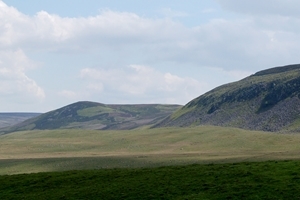 The study found high numbers of breeding curlews. Researchers estimated that Upper Teesdale supports around 1,764 breeding pairs, equivalent to approximately 3% of the UK breeding population. Curlews were present in 99% of surveyed squares, although densities varied between habitats. The highest densities were on rough grazing at an average of 16.2 birds/km² and grass moor at 11.8 birds/km², while the lowest densities were on unmanaged blanket bog at 3.4 birds/km².
The habitat covering the largest area was blanket bog managed by burning or cutting; here curlew densities were twice as high as on unmanaged bog. This suggests that grouse‑moor vegetation management creates conditions more suitable for curlews, likely through increased structural diversity and improved foraging opportunities.
Breeding success was high and appeared sufficient not only to sustain but potentially increase numbers breeding locally. Of 12 curlew nests monitored in 2014, 75% hatched, while camera monitoring in 2022-23 found that 70% of 50 nests hatched successfully. Across all monitored wader species, 78% of nests hatched, with 19% lost to predation. Most importantly, curlew productivity was estimated at around 1.0 fledglings per pair in Upper Teesdale, and 1.1 fledglings per pair across seven northern England sites. This is almost double the 0.5-0.6 fledglings per pair thought necessary to maintain a stable population.
Despite national declines, curlew numbers in Upper Teesdale and the wider North Pennines National Landscape were stable. Repeat surveys conducted around a decade apart found only a 3% decline over ten years, a change that was not statistically significant.
Camera monitoring showed that predators were responsible for most nest losses. The most frequent clutch predators recorded were badgers, stoats and sheep. Only one fox was recorded and no corvids, contrary to what was found in similar studies, reflecting the effectiveness of the culling operations by gamekeepers across most of the study area.
What this means
The study suggests that Upper Teesdale remains one of the UK’s most important curlew strongholds because it combines high breeding densities, high breeding success and long-term stability in numbers at a time when the species is declining across much of Britain.
This success appears to result from a combination of factors working across the landscape, including extensive open habitats, low-intensity livestock farming, limited afforestation, active habitat management on grouse moors and legal predator control. Across the seven estates included in the study, 22 full-time gamekeepers carried out predator management at a landscape scale rather than on isolated sites.
The findings also support previous research showing that predator control can substantially improve wader breeding success. A long-term experiment in Northumberland found that year-round predator control produced three-fold higher breeding success in curlews, lapwings and golden plovers, while a wider UK study found curlew productivity was approximately four times higher on grouse moors (1.1 fledglings per pair) than on comparable sites without predator control (0.3 fledglings per pair).
The study also highlights that predator communities change when some species are culled and others are not. Because fox and corvid numbers were reduced to low levels, most identified nest losses were caused by badgers and stoats, suggesting that successful curlew conservation depends on understanding which predators have the greatest impact locally.
Overall, the study concludes that curlew conservation is most likely to succeed when carried out across large, connected landscapes. In Upper Teesdale, the combination of habitat management and predator control has created conditions in which curlews achieve breeding success well above the level needed to maintain their numbers, helping to explain why this area remains a nationally important stronghold for the species.
Read the original paper
Baines, D. & Aebischer, N.J. (2026) High and stable Curlew Numenius arquata numbers on low-intensity farmland and moorland for Red Grouse Lagopus Scotica recreational shooting in northern England. Bird Study, 73,2.