Bearded tit
Unmistakable, quite unlike any other reed dwelling bird in the UK, but confusingly more closely related to larks!
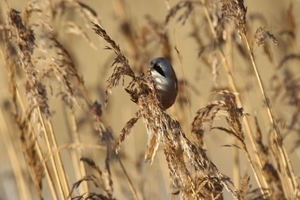 At this time of year I like to go down to the coast as the season changes, see migrants coming in, and enjoy a quieter coastline. Sometimes areas seen as not so rich in wildlife can be little havens as fewer people visit when it wouldn’t be worth a birders ‘tick-list’ to travel to, but I distinctly remember seeing this species for the first time, just off the road on the edge of a reedbed where the River Meon meets the sea, near to the sea on the edge of Fareham in Hampshire, of all places.
We had visited the Titchfield Haven National Nature Reserve about 11 years ago, spending most of the day sat in freezing bird hides with tepid coffee, scanning the scrapes, pool and horizon and saw next to nothing apart from a water rail. But as we left the site and were heading back to the car, we bumped into my best friend and her husband out doing the same thing. As we stood chatting, we heard the chatter of a flock of noisy bearded tits (Panurus biarmicus), or bearded reedlings as some may call them – a metallic, ‘pining’ call – working their way along the reedbed, feeding and chattering to each other as they went. This was my first time seeing them and I have loved them ever since, as they are so elusive, concealed among dense reedbeds out of sight and access from human eyes.
Identification
They are slightly bigger than a long-tailed tit. The adult male is unmistakable as their body is predominantly warm cinnamon-brown, with a blue-grey head and striking black moustachial patches descending from the yellow eyes.
Female bearded tits are paler, and they have buff undertail coverts. On the head, the face and crown are dull brown, with some darker brown mottling in the centre. The lores, chin, throat, and sides of the neck are grey.
Both sexes possess exceptionally long tails that help them in their acrobatics through the reeds, providing them with balance while climbing, straddling reeds and feeding among slender reed stems. Juveniles are similar to females but with less chestnut above, and on the flanks and upper tail. The lower mantle is black and the wings are black with pale edges. The underparts are duller.
Young males have black lores, yellow-green eyes, and a yellow bill. Young females have grey lores, and a darker bill.
- Average length: 12.5-15.5cm
- Average lifespan: 3 years
- Average wingspan: 16-18cm
Classification
The species was scientifically described by Carl Linnaeus in 1758 as Parus biarmicus. Parus is the genus name for tit family, reflecting the belief that it was a member. Its relationships puzzled ornithologists for centuries, and at different times it was associated with parrotbills, warblers and babblers. Modern research has shown it to be a highly distinctive passerine without close living relatives, and it is now the sole species in their family Panuridae.
Its closest broader affinities appear to be with the larks.
Breeding
Their nests are built at the base of the reedbed from dead reeds and lined with softer reed heads and feathers, in which the female lays 4-8 cream-coloured eggs with dark brown markings. They are very effective monogamous breeders (mate faithful) and can have up to four overlapping broods between March and early September. Both parents will incubate the eggs for 10-14 days before hatching, and the young are fed for 12-16 days until they fledge.
Feeding
In the summer, bearded tits eat mainly invertebrates: mayflies, dragonflies, moths, beetles and mosquitoes, as well as spiders, slugs and snails. In the late autumn and winter they eat mainly seeds and aquatic plants. They forage in wetlands, muddy grounds and the edges of open water.
In autumn, birds may be seen ‘feeding’ on grit, which helps to facilitate their switch from a summer diet of reedbed insects to one mostly of reed seeds in the winter.
Where and when to see them
Reedbeds all year round on the south and east coasts of England and Scotland, but you will have to be patient and have a keen eye and ear! They are mostly active in the morning in dry and still conditions when they can be heard making a ‘ping’ call as they zoom between reeds or perform a split between the reed stalks.
Well-known places to look include RSPB Minsmere in Suffolk, Leighton Moss in Lancashire, Langford Lowfields in Nottinghamshire, Lodmoor in Dorset and the Tay Reedbeds in Scotland. But like I said, I have seen them on the coast near Fareham, on the edge of Portsmouth and the New Forest.
Bearded tit numbers were severely reduced by long, cold winters in the 20th century, and the species became restricted to a handful of sites in East Anglia and Kent. The species has since increased hugely in both numbers and range, and appears less susceptible to hard weather.
So, off you go, keep a keen eye and ear, and I hope you see these wonderful birds.
Megan Lock
Advisory
Photo credit: David Lock