Penny bun
An autumn prize, if you can get to them before the squirrels and slugs!
 It’s that time of year when as a family we head to the forest to listen and watch the the rut, to a particular place that I have been going to since I was a child. We went too early in October and heard nothing, so we waited and returned over half term as the weather had got a bit cooler. Sadly we just caught the tail end of the rut and only a few fallow bucks were still thrashing about, but not actively fighting or grunting and no reds to be seen.
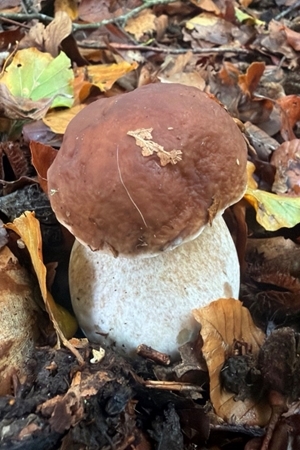
Nevertheless, a day out walking about in the woods, seeing no one, climbing trees, jumping streams, creeping through the bracken and making memories with my daughter is a day well spent. While we were walking through the beech and oak dominated woodland, we spotted a number of pristine penny bun mushrooms (Boletus edulis) popping out amongst the leaf litter alongside a flush of many other species. But these penny buns stood out as they are one of the stars of the mushroom world and generally at the end of their season in October.
What’s in a name?
You may already know this mushroom, but by another name – that’s why scientific names are so important, as they don’t change depending on where you are if the species is the same. The penny bun has many names across Europe, known as the cep (trunk, because of the fat stem) in France, porcini (little pigs) in Italy, and Steinpilz (stone mushroom) in Germany. It is one of the most sought-after edible boletes.
Identification
It is rather a chunky-looking mushroom with a cap that really looks like a well-baked bread roll – brown, dimpled and dome-shaped with a paler edge, 8–30cm across, and sticky when moist. Underneath the cap, the gills are white, with fine pores that age to yellow then turn green and spongy. The spore print is green/brown if you place one on a sheet of paper. The stalk (stem) is thick and swollen like a belly oak, and pale brown in colour with a white network pattern on the upper part, 8-25cm x 4-10cm.
Not to be confused with…
No poisonous mushrooms look similar, all the poisonous boletes such as the rare Devil’s bolete are either very red in the flesh or sponge, or stain blue immediately on cutting, so are easily distinguished. However, not to be confused with the similar-looking bitter bolete (Tylopilus felleus) and bay bolete (Imleria badia). It’s not poisonous but it tastes awful and has a slightly darker stem covered with a lighter, net-like mesh.
Fruiting season
Summer to autumn
Distribution
Penny bun is fairly common in the UK and Ireland, generally found in woodland with oak, beech, birch and coniferous trees, especially open ground – particularly wood edges and grassy clearings. They are also found in mainland Europe and Asia, and the USA where they call them the king bolete, although it is a debate whether they are the same species.
Most boletes, and certainly all of the common ones found in Britain and Ireland, are ectomycorrhizal fungi. This means that they form mutualistic relationships with the root systems of certain kinds but of trees and/or shrubs. This kind of symbiotic relationship the fungi help the tree to obtain vital minerals from the soil, and in return the root system of the tree delivers energy-rich nutrients, the products of photosynthesis, to the fungal mycelium.
Uses of penny bun
The penny bun has a fine flavour and texture, which makes it a well sought after species and is highly prized by chefs. They offer a number of health benefits, including natural antioxidants, minerals and vitamins, and are a rich source of fibre as well as being low in calories and saturated and unsaturated fat.
Mythology and symbolism
In folklore it is said that the best time to hunt for penny bun and other ceps is when it’s a full moon.
We didn’t pick the mushrooms we found, we had fun identifying them and leaving them for the wildlife to eat. As with every mushroom – only pick what you can confidentially identify and what is lawfully allowed!
Megan Lock
Advisory
Photo credit: Megan Lock