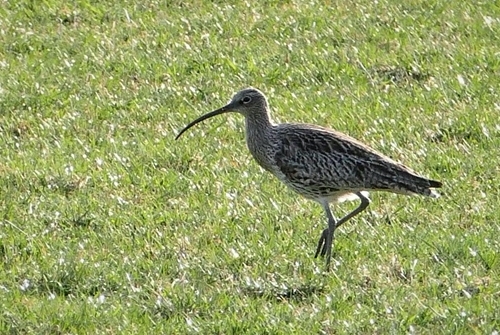
The haunting call of the curlew is one of the most evocative sounds of the British countryside. Yet behind that wild, bubbling song lies a species fighting for survival. With the Eurasian Curlew now one of the UK’s highest conservation priorities, understanding its life cycle is essential to understanding how, and why, we must act to protect it.
Curlews are long-lived birds, often surviving for 20-30 years, but they are also slow to reproduce, typically successfully raising very few chicks over a lifetime. This means populations depend heavily on adults surviving for many years, and require at least occasionally successful breeding seasons. GWCT researchers are working with communities and land managers across England, Scotland and Wales at almost every stage of the curlews life that we can reach to help save this iconic species.
Recently, a curlew tagged by our researcher Elli Rivers was officially recognised as the oldest living curlew on record, at nearly 34 years old. While this is an extraordinary achievement, it also highlights a troubling reality. Curlew populations in the UK are ageing. Their long lifespan masks the speed of decline, making population losses less immediately visible. Without sufficient recruitment of young birds, this iconic species may be far closer to the brink of collapse than we realise.
Here’s a journey through the curlew’s year, from the moment they return to their breeding grounds to the perilous migration that follows as a ground nesting bird, and the threats they face at every stage of their lives.
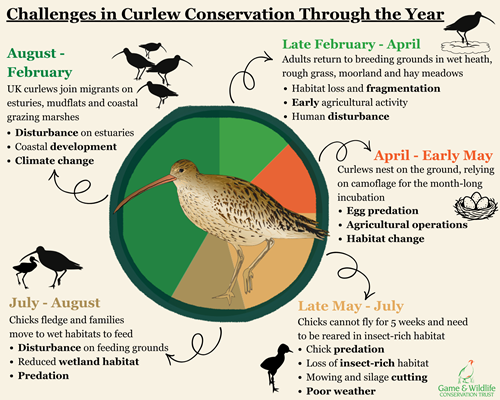
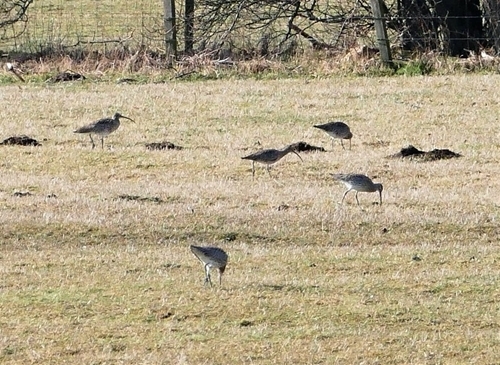
1. Returning to the Breeding Grounds (Late February – April)
As winter loosens its grip, curlews begin returning to their breeding grounds. In the UK, they favour wet heathland, rough grasslands, moorland fringe, rushy pasture and upland hay meadows, open landscapes where their long bills and excellent visibility help them feed and avoid predators.
Curlews show strong site fidelity, often returning to the same fields or hillsides year after year. Because of this loyalty, successful reproduction in their favoured areas is essential – once a site becomes unsuitable, successful relocation is challenging.
Threats at this stage
- Habitat loss and fragmentation:
Much of the UK’s traditional grassland and upland habitat has been drained, improved, or converted to silage production, reducing suitable breeding areas. Fragmentation also increases edge effects, bringing curlews into closer contact with predators and human activity.
- Early agricultural activity:
Rolling, mowing or grazing in early spring can disturb or displace returning birds before nesting begins, sometimes causing pairs to abandon otherwise suitable areas.
- Human disturbance:
Dogs off leads, walkers heading off footpaths, and early-season recreational activity can repeatedly flush birds. Even short disturbances at this stage can prevent pairs from settling and initiating a nest.
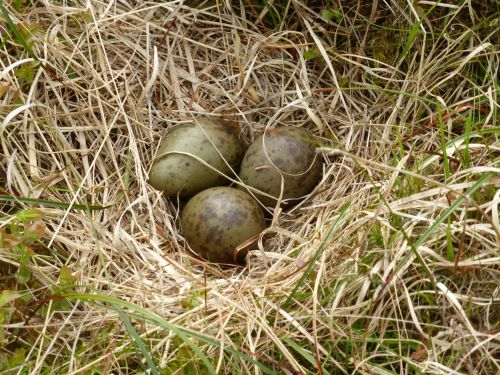
2. Nesting and Egg Laying (April – early June)
Curlews nest on the ground, relying on camouflage to hide their four olive-brown eggs. The nest is little more than a shallow scrape lined with vegetation. Adults incubate for nearly a month, but this is one of the most vulnerable periods in the entire life cycle.
Threats at this stage
- Predation of eggs by foxes, crows, stoats and badgers:
Nest predation is now one of the leading causes of curlew breeding failure across the UK. GWCT nest-camera studies show that mammalian predators, particularly foxes and badgers, account for a large proportion of losses at ground nests, often removing entire clutches in a single visit.
- Agricultural operations:
Long gone are the days of harvesting by hand, cutting early silage can destroy nests before chicks hatch, and even light tractor traffic can crush eggs. Livestock also pose a threat with our researchers even finding some evidence of sheep disturbing eggs, particularly in rushy or tussocky pastures.
- Habitat change:
Intensified grassland management leads to uniform, fast-growing swards that do not provide the structure curlews need for nesting. Tree plantations also put curlew off, GWCT research has highlighted that they avoid nesting in areas near woods, even small fragmented pockets because they provide cover for predators and perches for corvids or raptors.
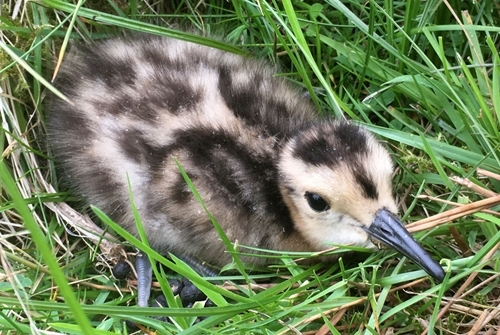
3. Chick Rearing (late May – July)
Curlew chicks are precocial, able to walk and feed themselves within hours of hatching. But they cannot fly for at least five weeks, meaning they rely on high-quality insect-rich habitat to grow quickly and avoid predators.
Threats at this stage
- Chick predation:
With no ability to fly and limited camouflage once they start moving, chicks are highly vulnerable to foxes, corvids and raptors. This is the stage where well-timed and targeted predator control has been shown to make a great difference for egg and chick survival.
- Loss of invertebrate-rich habitat:
Pesticides, intensive grazing and reseeding reduce insect abundance, the very food chicks depend on. Even where nests survive, well positioned quality habitat that makes insect food items accessible and abundant is essential to prevent starving chicks.
- Mowing and silage cutting:
If delayed hatching pushes chick growth into silage-cutting season, whole broods can be lost. Projects such as Curlew Connections have been testing the efficacy of subsidising farmers to delay their silage cuts in known curlew nesting areas.
- Poor weather:
Cold, wet springs significantly reduce chick survival. Some of our research has also shown that, at least for another ground nesting bird - lapwing, cold weather can increase predation pressure from badgers, whose preferred worm food becomes less available in these conditions.
This stage is the pinch point in the curlew life cycle, where most breeding attempts fail.
4. Fledging and Post-Breeding (July – August)
Once chicks fledge, curlew families move to wetter ground, edges of moorland, or coastal marshes to feed. Juveniles need to build strength for autumn migration or their first winter.
Threats at this stage
- Disturbance on feeding grounds:
Dog walking, recreation and early grouse management activity can push birds into poorer-quality areas. Community engagement near curlew sites is important.
- Reduced wetland habitat:
Drainage and drying of wet grasslands leave fewer safe foraging areas. GWCT research highlights how crucial good habitat is for curlew, well-considered re-wetting and preservation of existing sites is essential. Working with land managers to achieve this may help reverse curlew declines.
This stage is crucial for juveniles: survival here determines whether a chick ever contributes to the breeding populations, often several years later.
5. Autumn Migration and Wintering (August – February)
UK-bred curlews join migrants from Scandinavia and Russia on estuaries, mudflats and coastal grazing marshes. Winter survival depends on access to safe, undisturbed feeding and roosting sites.
Threats at this stage
- Disturbance on estuaries:
Frequent flushing by walkers, dogs or water sports reduces feeding time and increases energy use.
- Coastal development:
Loss of mudflats through development and coastal squeeze removes essential feeding habitat.
- Climate change:
Sea-level rise threatens intertidal feeding grounds; stormier winters reduce feeding opportunities.
Although adult survival is relatively high, continued loss and disturbance of coastal habitat increases winter stress and reduces breeding success the following spring.
Hope for the Curlew
Despite the challenges, targeted conservation efforts are making a difference:
- Predator management and nest protection can significantly increase chick survival. GWCT teams have been developing a number of ways to protect nests from AI camera systems to protective nest cages.
- Agri‑environment schemes that promote late cutting, light grazing and wet features benefit breeding birds. GWCT research that provides the data highlighting the value of this government investment must continue to support and develop such schemes.
- Habitat restoration on moorland fringe and rush pasture recreates the open, insect-rich conditions curlews need. Research shows that land managed for game often support key habitat management that in turn benefits wider wildlife including curlew.
- Disturbance‑sensitive management on estuaries helps ensure safe wintering sites.
Partnerships between farmers, conservation groups, local communities and researchers are proving crucial. Where these efforts combine, curlew numbers can stabilise and in some places, recover.